SEBORRHEA DOES NOT BEGIN WITH OILY SHINE
That is why working only at the surface of the skin is not enough.
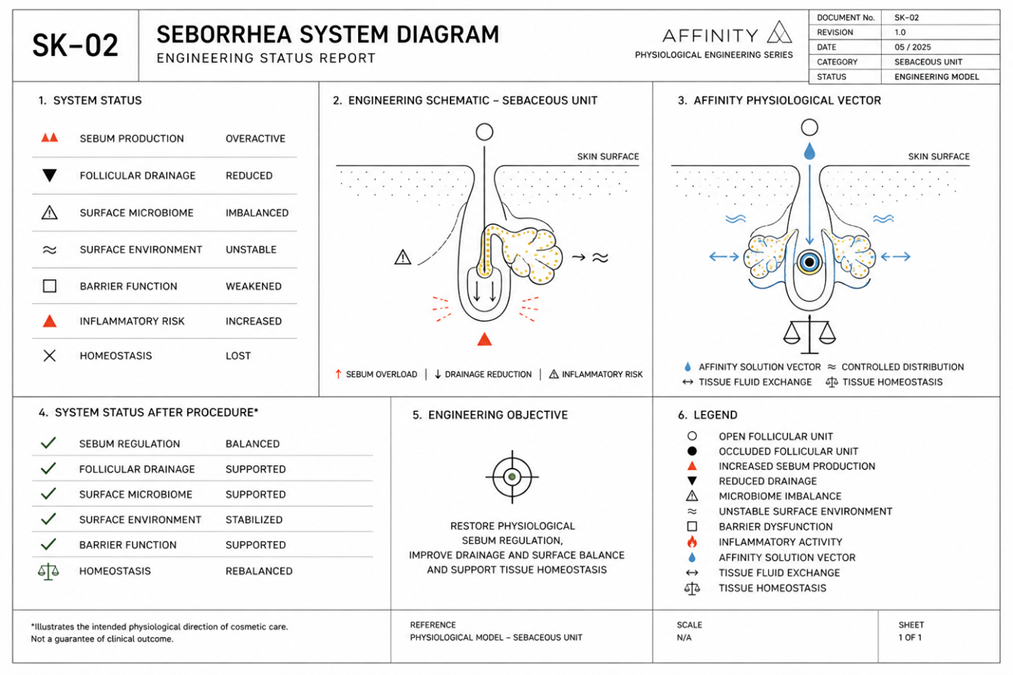
Seborrhea is associated with changes in the function of the pilosebaceous unit of the skin — primarily with sebaceous gland activity, the composition of sebum, the condition of the follicular openings, and the interaction of these factors with the skin’s microenvironment.
Sebum itself is not the problem.
It is part of the skin’s natural protective system.
The problem arises when the balance between the following factors is disrupted:
Seborrhea is therefore not simply “oily skin.”
It is a change in the skin’s microenvironment.
This is where the different Affinity approach begins.
Do Not Strip the Skin. Work with Its Natural Pathways.
Affinity uses the skin’s natural anatomical structures — pores and hair follicles — for professional treatment while preserving the integrity of the skin surface and stratum corneum.
This represents a fundamentally different approach to professional skincare.
Instead of continuously removing sebum from the surface, the technology allows professionals to work with the condition of the skin around the pores and follicular openings, where many of the interactions between sebum, keratin, and the microbial environment take place.
Why Does the Microenvironment Matter?
With seborrhea, the skin may become:
The interaction between sebum and microorganisms that naturally inhabit the skin is particularly important.
Under normal conditions, the skin microbiome is part of its physiological ecosystem.
Therefore, the goal of professional skincare is not to “sterilize” the surface or remove all sebum.
The goal is to support conditions in which the skin can maintain its physiological balance.
Seborrhea and Malassezia
Fungi of the genus Malassezia are a normal part of the skin microbiome, particularly in areas rich in sebaceous glands.
Therefore, the mere presence of Malassezia does not indicate disease.
What matters is the interaction between:
sebum → microbial environment → skin barrier → inflammatory response.
In certain skin conditions, this interaction may contribute to inflammation and scaling.
That is why excessive degreasing or aggressive cleansing does not necessarily improve the condition of the skin.
In some cases, constantly removing surface lipids may increase irritation and disrupt the barrier environment.
Affinity offers a different approach:
do not disrupt the microenvironment → do not compromise the barrier → work gently with the surface and the skin’s natural pathways.
Affinity Works Beyond What Is Visible as Oily Shine
Oily shine is only the visible result.
Behind it is an interconnected system:
sebaceous gland → hair follicle → follicular opening → sebum → stratum corneum → microbiome → barrier → inflammatory response.
Therefore, professional care for seborrheic skin should not be reduced to:
“remove the oil.”
The condition of the entire tissue environment should also be taken into account.
The following factors are also important for the skin:
How Does Affinity Create This Approach?
At the core of the system is a treatment nozzle with two micro-openings, each approximately eight times thinner than a human hair.
When the nozzle comes into contact with the skin, it creates a controlled vacuum interaction.
As the nozzle moves smoothly across the skin, a professional solution is directed toward the pores and follicular openings — the skin’s natural pathways for interaction.
Affinity therefore combines:
controlled negative pressure
+
professional solution
+
the skin’s natural anatomical pathways.
Without creating an artificial channel.
Without compromising the integrity of the stratum corneum.
What Does This Add to a Professional Program?
Affinity allows the professional to work across several levels at the same time:
SKIN SURFACE
↓
gentle removal of excess surface sebum and impurities
FOLLICULAR OPENINGS
↓
working with accumulated surface components
PROFESSIONAL SOLUTION
↓
contact with the skin through its natural anatomical pathways
STRATUM CORNEUM
↓
supporting its physiological hydration
TISSUE ENVIRONMENT
↓
gentle mechanical action without additional trauma
This makes Affinity a relevant tool for professional programs addressing:
In cases of pronounced inflammation, an infectious process, or clinically significant seborrheic dermatitis, Affinity should be considered as one component of a professional care program — not as a substitute for dermatological diagnosis or prescribed medical treatment.
The Affinity Philosophy
We do not view seborrheic skin as a surface that needs to be constantly stripped of oil.
Sebum is not the enemy of the skin.
It is part of its physiology.
Therefore, the goal of professional skincare is not to remove as much sebum as possible, but to work with the conditions that allow the skin to maintain its natural balance.
Not aggressive degreasing.
Not disruption of the skin barrier.
Not a constant battle with the surface.
Instead:
gentle cleansing
→ working with the skin’s natural pathways
→ supporting the barrier environment
→ professional solution
→ creating conditions for physiological skin function.
Affinity works not only with what is visible.
Affinity
Working beyond the surface. Working with the skin’s microenvironment.
That is why working only at the surface of the skin is not enough.
Seborrhea is associated with changes in the function of the pilosebaceous unit of the skin — primarily with sebaceous gland activity, the composition of sebum, the condition of the follicular openings, and the interaction of these factors with the skin’s microenvironment.
Sebum itself is not the problem.
It is part of the skin’s natural protective system.
The problem arises when the balance between the following factors is disrupted:
- sebum production;
- its composition and distribution across the skin surface;
- the condition of the hair follicle openings;
- keratinization processes;
- skin barrier function;
- the skin’s microbial ecosystem;
- local inflammatory response.
Seborrhea is therefore not simply “oily skin.”
It is a change in the skin’s microenvironment.
This is where the different Affinity approach begins.
Do Not Strip the Skin. Work with Its Natural Pathways.
Affinity uses the skin’s natural anatomical structures — pores and hair follicles — for professional treatment while preserving the integrity of the skin surface and stratum corneum.
This represents a fundamentally different approach to professional skincare.
Instead of continuously removing sebum from the surface, the technology allows professionals to work with the condition of the skin around the pores and follicular openings, where many of the interactions between sebum, keratin, and the microbial environment take place.
Why Does the Microenvironment Matter?
With seborrhea, the skin may become:
- more oily and shiny;
- prone to sebum accumulation around follicular openings;
- uneven in the condition of the stratum corneum;
- more sensitive to irritating factors;
- prone to inflammatory changes;
- more susceptible to imbalance within the microbial ecosystem.
The interaction between sebum and microorganisms that naturally inhabit the skin is particularly important.
Under normal conditions, the skin microbiome is part of its physiological ecosystem.
Therefore, the goal of professional skincare is not to “sterilize” the surface or remove all sebum.
The goal is to support conditions in which the skin can maintain its physiological balance.
Seborrhea and Malassezia
Fungi of the genus Malassezia are a normal part of the skin microbiome, particularly in areas rich in sebaceous glands.
Therefore, the mere presence of Malassezia does not indicate disease.
What matters is the interaction between:
sebum → microbial environment → skin barrier → inflammatory response.
In certain skin conditions, this interaction may contribute to inflammation and scaling.
That is why excessive degreasing or aggressive cleansing does not necessarily improve the condition of the skin.
In some cases, constantly removing surface lipids may increase irritation and disrupt the barrier environment.
Affinity offers a different approach:
do not disrupt the microenvironment → do not compromise the barrier → work gently with the surface and the skin’s natural pathways.
Affinity Works Beyond What Is Visible as Oily Shine
Oily shine is only the visible result.
Behind it is an interconnected system:
sebaceous gland → hair follicle → follicular opening → sebum → stratum corneum → microbiome → barrier → inflammatory response.
Therefore, professional care for seborrheic skin should not be reduced to:
“remove the oil.”
The condition of the entire tissue environment should also be taken into account.
The following factors are also important for the skin:
- barrier function;
- hydration of the stratum corneum;
- microcirculation;
- lymphatic exchange;
- condition of surface and follicular structures;
- the skin’s ability to tolerate subsequent care.
How Does Affinity Create This Approach?
At the core of the system is a treatment nozzle with two micro-openings, each approximately eight times thinner than a human hair.
When the nozzle comes into contact with the skin, it creates a controlled vacuum interaction.
As the nozzle moves smoothly across the skin, a professional solution is directed toward the pores and follicular openings — the skin’s natural pathways for interaction.
Affinity therefore combines:
controlled negative pressure
+
professional solution
+
the skin’s natural anatomical pathways.
Without creating an artificial channel.
Without compromising the integrity of the stratum corneum.
What Does This Add to a Professional Program?
Affinity allows the professional to work across several levels at the same time:
SKIN SURFACE
↓
gentle removal of excess surface sebum and impurities
FOLLICULAR OPENINGS
↓
working with accumulated surface components
PROFESSIONAL SOLUTION
↓
contact with the skin through its natural anatomical pathways
STRATUM CORNEUM
↓
supporting its physiological hydration
TISSUE ENVIRONMENT
↓
gentle mechanical action without additional trauma
This makes Affinity a relevant tool for professional programs addressing:
- oily and seborrheic skin;
- pronounced oily shine;
- a tendency toward follicular opening congestion;
- enlarged pores;
- comedonal skin;
- skin prone to inflammatory changes;
- seborrheic conditions as part of a comprehensive care program;
- skin with a compromised barrier following excessive degreasing;
- skin preparation before subsequent aesthetic procedures;
- maintenance care between medical stages of treatment.
In cases of pronounced inflammation, an infectious process, or clinically significant seborrheic dermatitis, Affinity should be considered as one component of a professional care program — not as a substitute for dermatological diagnosis or prescribed medical treatment.
The Affinity Philosophy
We do not view seborrheic skin as a surface that needs to be constantly stripped of oil.
Sebum is not the enemy of the skin.
It is part of its physiology.
Therefore, the goal of professional skincare is not to remove as much sebum as possible, but to work with the conditions that allow the skin to maintain its natural balance.
Not aggressive degreasing.
Not disruption of the skin barrier.
Not a constant battle with the surface.
Instead:
gentle cleansing
→ working with the skin’s natural pathways
→ supporting the barrier environment
→ professional solution
→ creating conditions for physiological skin function.
Affinity works not only with what is visible.
Affinity
Working beyond the surface. Working with the skin’s microenvironment.