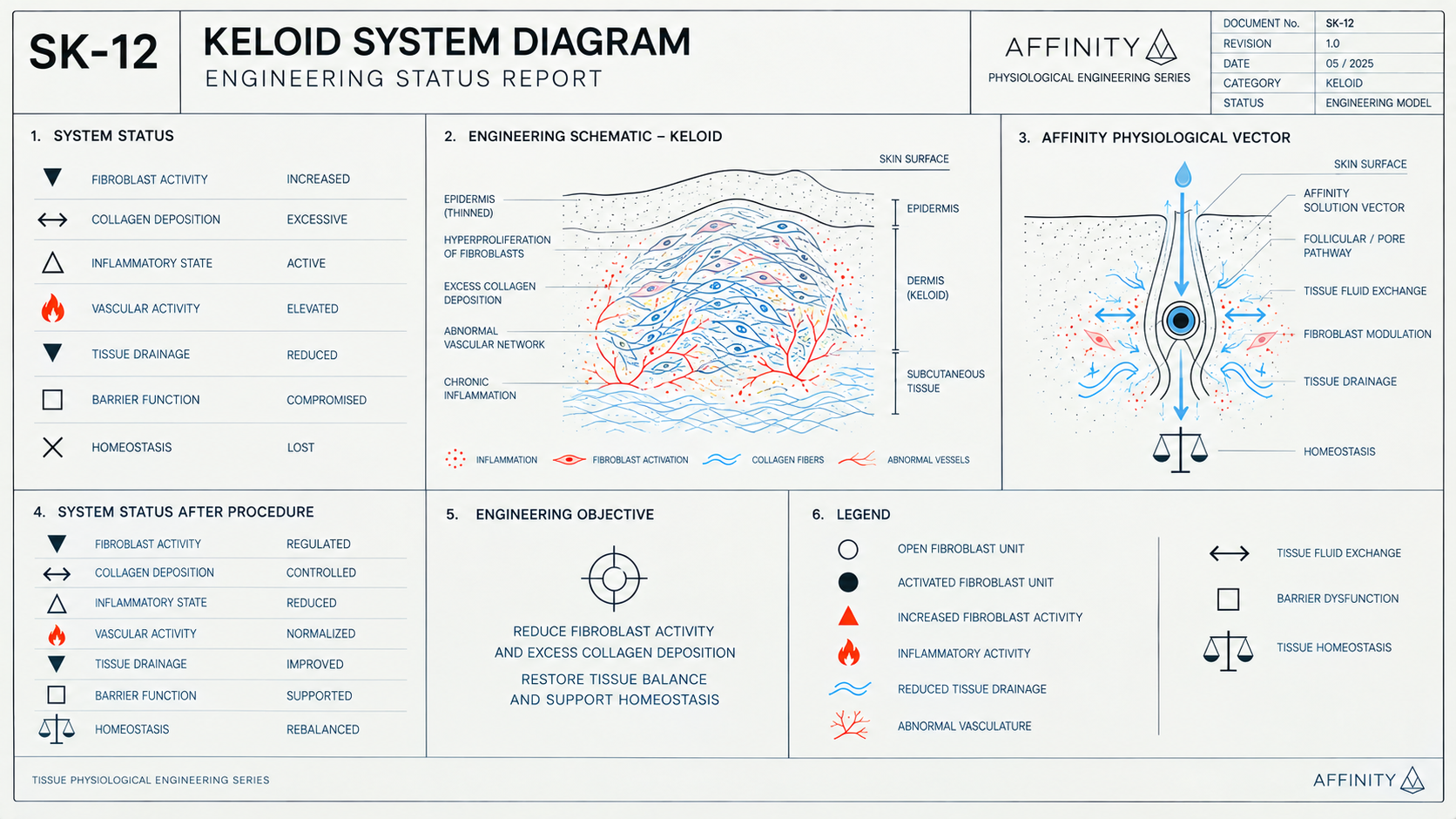
KELOID SCARS — WHEN TISSUE SHOULD NOT BE FORCED TO HEAL ALL OVER AGAIN
THIS IS NOT SIMPLY “A SCAR THAT IS TOO LARGE.”
A keloid is a distinct form of pathological scarring.
After the skin is injured, the body needs to close the defect, form new tissue, and gradually remodel it.
But in keloid scarring, this process extends beyond normal remodeling.
Excess scar tissue forms, and a keloid may continue to grow beyond the boundaries of the original wound.
It can appear months or even years after the initial injury and may persist for a long time.
That is why one question becomes particularly important:
NOT “HOW CAN WE DESTROY IT MORE AGGRESSIVELY?”
But:
“HOW CAN WE WORK WITH THE TISSUE WITHOUT TRIGGERING NEW TRAUMA?”
WHERE DOES A KELOID COME FROM?
The exact cause of keloid scarring is not fully understood.
However, it is known to be associated with dysregulation of the healing process, excessive fibroblast activity, and accumulation of extracellular matrix components, particularly collagen.
The triggering event can be almost any type of injury:
SURGERY
→ BURN
→ TRAUMA
→ ACNE
→ BITE
→ PUNCTURE
→ INFLAMMATION
→ INJECTION
→ EVEN MINOR INJURY.
Sometimes a person has long forgotten the event that initiated the process.
But the keloid remains.
And sometimes — it continues to grow.
A KELOID CAN APPEAR AT ANY AGE
Keloid scarring is particularly common in younger people, but age itself does not exclude its development.
Keloids can occur in children, adolescents, adults, and older people; cases have been described in which they continue to enlarge over many years.
Therefore, in our approach, there is no concept of: “It is an old scar — so nothing can be done about it anymore.”
There is another question: WHAT IS THE CONDITION OF THE TISSUE RIGHT NOW?
A KELOID IS NOT JUST A SCAR
A conventional scar may gradually become softer and less noticeable over time.
A hypertrophic scar usually remains within the boundaries of the original wound and may decrease over time.
A keloid behaves differently.
It may:
BECOME RAISED
→ BECOME FIRMER
→ GROW
→ EXTEND BEYOND THE ORIGINAL WOUND
→ CREATE TENSION
→ CAUSE ITCHING OR PAIN.
This is precisely why it should not be viewed as an ordinary cosmetic irregularity.
WHERE DOES AFFINITY COME IN?
This is where our philosophy becomes particularly relevant: DO NOT DESTROY TISSUE THAT IS ALREADY SHOWING AN EXCESSIVE RESPONSE TO INJURY.
Affinity makes it possible to work with the skin differently.
Without abrasive action.
Without cutting the tissue.
Without puncturing it.
Without forcing it to go through another full cycle of injury and repair.
Instead, using:
CONTROLLED VACUUM
→ GENTLE MECHANICAL ACTION
→ DELIVERY OF A SELECTED SOLUTION
→ LOCALIZED WORK
→ A DRAINAGE COMPONENT
→ GRADUAL MONITORING OF THE TISSUE RESPONSE.
VACUUM HERE IS NOT SIMPLY “SUCTION”
Controlled vacuum makes it possible to work with tissue mechanically.
The skin and superficial tissues are gently drawn into the working area of the applicator.
This creates the possibility to:
ENGAGE
→ MOBILIZE
→ MOVE FLUID
→ SUPPORT DRAINAGE
→ ASSESS CHANGES IN THE TISSUE.
And this is particularly interesting in situations where we do not want to add unnecessary mechanical trauma.
DRAINAGE IS A SEPARATE PART OF THE APPROACH
A keloid is not only about tissue density.
There is also a surrounding tissue environment around the altered area.
Therefore, the mechanical action of Affinity can be considered not only as work directly on the scarred area, but also as work with the surrounding tissues and their fluid dynamics.
KELOID
→ SURROUNDING TISSUE
→ LOCAL DRAINAGE
→ MOBILITY
→ TISSUE BALANCE.
Not a promise to “dissolve the keloid.”
But a completely different objective: TO WORK WITH THE TISSUE ENVIRONMENT WITHOUT DESTROYING IT.
THIS IS WHERE THE ABILITY TO SELECT THE SOLUTION BECOMES IMPORTANT
Affinity does not tie the procedure to one fixed solution.
The professional can build a sequence according to the specific objective and the current condition of the skin:
PREPARATION
→ SELECTED SOLUTION
→ CONTROLLED VACUUM
→ LOCALIZED WORK
→ DRAINAGE
→ FINISHING CARE.
In other words, the device becomes a platform for a controlled procedure, rather than a standalone “keloid remedy.”
This makes it possible to adapt the approach to different areas of the body.
AND IT DOES NOT MATTER WHERE THE KELOID IS LOCATED
EARLOBE.
CHEST.
SHOULDER.
BACK.
NECK.
ABDOMEN.
POSTOPERATIVE AREA.
AREA AFFECTED BY ACNE.
Skin differs from one anatomical area to another in thickness, underlying structures, tension, and functional load.
But the principle remains: ASSESS → ADAPT → WORK LOCALLY → MONITOR THE RESPONSE.
ESPECIALLY IMPORTANT: A KELOID SHOULD NOT BE “PROVOKED”
This is a fundamental distinction from many aggressive approaches.
Surgical excision of a keloid can itself be followed by recurrence, sometimes with formation of an even more pronounced keloid. For this reason, medical approaches are often combined — for example, surgical removal with subsequent measures aimed at reducing recurrence, or intralesional injections, silicone, pressure therapy, cryotherapy, and laser approaches, depending on the individual situation.
Therefore, the idea of:
“LET’S TRAUMATIZE THE TISSUE AGAIN SO THAT IT REMODELS”
requires particular caution in keloid-prone tissue.
And this is where the non-destructive principle of Affinity becomes particularly interesting.
KELOID AND “AESTHETIC LEGACY”
A modern patient may present not only with a naturally occurring scar.
They may have a history of:
SURGERY
→ REVISION SURGERY
→ INJECTIONS
→ FILLERS
→ LESION REMOVAL
→ LASER
→ PIERCING
→ ACNE
→ REPEATED TRAUMA.
And if the body has already demonstrated a tendency toward keloid formation, this history of interventions becomes particularly important.
THIS IS NO LONGER JUST A SCAR.
It is TISSUE WITH A HISTORY OF RESPONDING TO INJURY.
And this is precisely the kind of tissue we especially want to avoid unnecessarily traumatizing again.
AFFINITY IS NOT A “KELOID DESTROYER”
And this is perhaps the most honest — and at the same time the strongest — positioning.
Affinity should not promise what cannot currently be substantiated:
NOT “DISSOLVES KELOIDS”
NOT “REMOVES COLLAGEN”
NOT “TREATS KELOIDS.”
Its potentially strong side is different:
TO WORK WITH TISSUE WITHOUT MAKING NEW TRAUMA A REQUIREMENT OF THE PROCEDURE.
GENTLY
→ BUT CONSISTENTLY.
LOCALLY
→ BUT WITH CONSIDERATION FOR THE SURROUNDING TISSUE.
MECHANICALLY
→ BUT NON-DESTRUCTIVELY.
WITH A SOLUTION
→ BUT WITH A CONTROLLED PROCEDURAL LOGIC.
WITH A DRAINAGE COMPONENT
→ BUT WITHOUT PROMISING TO “PULL OUT” THE KELOID.
THIS IS HOW WE SHOULD LOOK AT THE SKIN
Not:
NORMAL SKIN → EASY TO WORK WITH
KELOID → DO NOT TOUCH.
But:
ANY SKIN → ASSESS ITS CONDITION → UNDERSTAND ITS HISTORY → SELECT THE APPROPRIATE MECHANICAL APPROACH.
From sole to crown.
At any age.
On any part of the body.
Even where the skin has already shown that it can respond to injury too actively.
DO NOT DESTROY → DO NOT PROVOKE → MOBILIZE → SUPPORT DRAINAGE → MONITOR → ADAPT.
Affinity is not always about the strength of the intervention.
Sometimes, true strength lies in the ability to work with tissue without forcing it to start all over again.