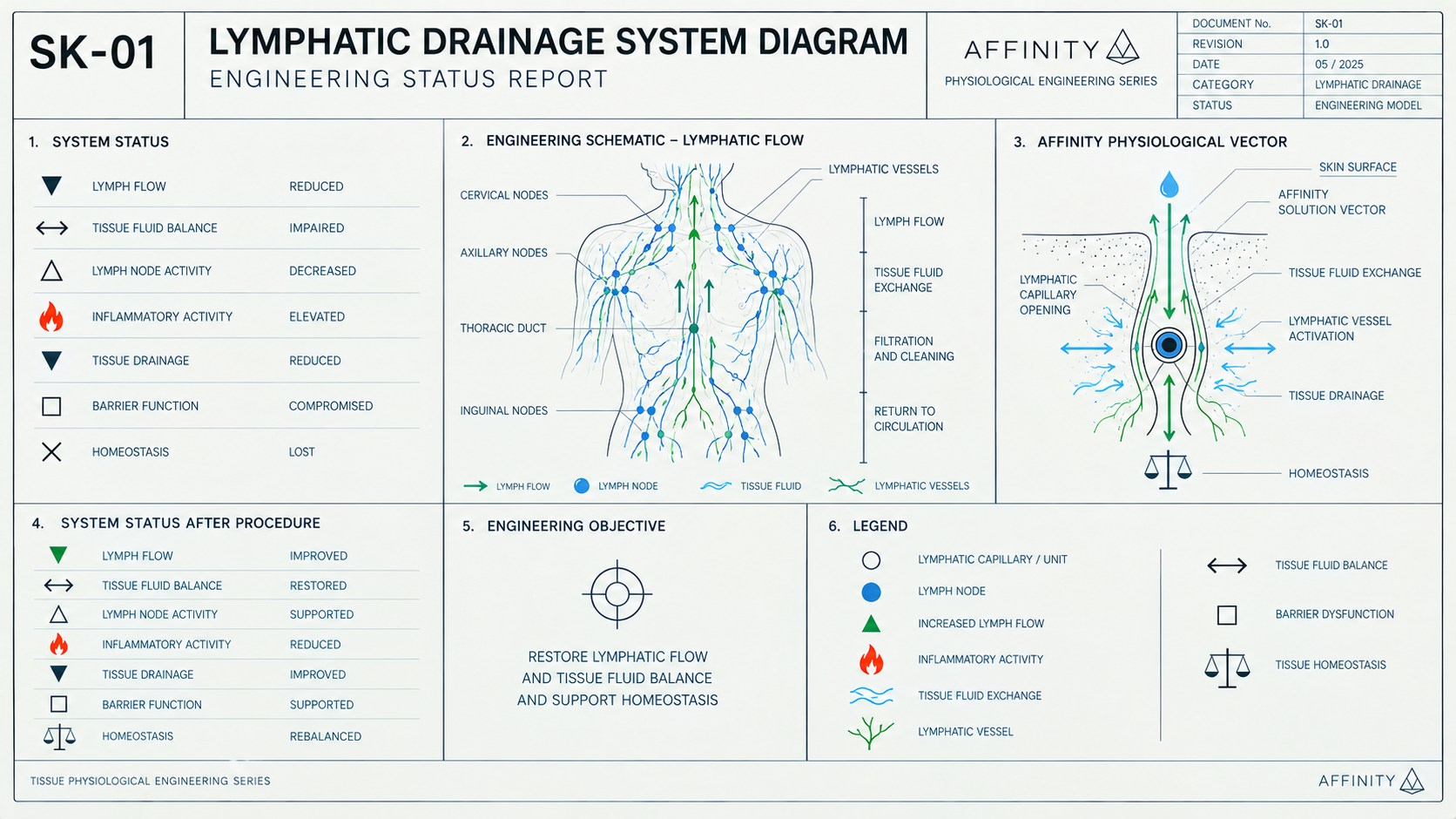
LYMPHATIC DRAINAGE — START WITH BALANCE
There are procedures that immediately begin by addressing a specific problem:
ACNE → ROSACEA → PUFFINESS → PIGMENTATION → FIBROSIS → INGROWN HAIR → SEBORRHEA → HAIR LOSS → AGE-RELATED CHANGES.
But tissue has another level that exists before the specific problem:
TISSUE FLUID → LYMPHATIC OUTFLOW → MICROENVIRONMENT → HOMEOSTASIS.
Therefore, within our concept, the work does not necessarily have to begin with the problem.
It begins with: BALANCE.
LYMPHATIC DRAINAGE IS NOT JUST ABOUT AESTHETICS
The lymphatic system functions throughout the entire body.
Therefore, lymphatic drainage should not be limited to the face, neck, or aesthetic concerns.
HEAD → NECK → FACE → TORSO → ARMS → LEGS
— all of these are parts of one interconnected lymphatic system.
When appropriate, Affinity can be used for sequential work across different areas of the body, adapting the approach to anatomy, tissue condition, and the specific objective.
LYMPHATIC DRAINAGE IS NOT A “FACIAL PROCEDURE.”
It is an anatomical principle of working with the body as a whole.
AN IMPORTANT DISTINCTION: AGE AND SKIN CONDITION
This is where Affinity differs fundamentally from many procedures based on aggressive action on the skin surface.
If a method requires: DISRUPT THE BARRIER → HEAT → INTENSIVELY EXFOLIATE → PUNCTURE → CREATE CONTROLLED TRAUMA,
its application naturally depends on skin condition, age, sensitivity, and other factors.
Affinity’s approach to lymphatic drainage is different.
CONTROLLED VACUUM → CONTROLLED LIQUID → LOCALIZED MECHANICAL ACTION → ADAPTATION TO THE TISSUE.
There is no need to make skin damage a prerequisite for the procedure.
Therefore, the concept can potentially be adapted to: DIFFERENT AGES → DIFFERENT SKIN THICKNESS AND DENSITY → DIFFERENT LEVELS OF REACTIVITY → DIFFERENT DERMATOLOGICAL CONDITIONS.
Not because “everything is allowed.”
But because the intensity, route, treatment area, vacuum, and sequence can be adapted without changing the fundamental principle.
It is precisely this adaptability that broadens the range of possible applications.
NOT “ONE PROCEDURE FOR EVERYONE”
This is even more important.
ONE PRINCIPLE ≠ ONE IDENTICAL PROCEDURE.
The tissue of a young person and that of someone aged 70+ will be different.
Dry skin and oily skin are different.
Dense fibrotic tissue and soft tissue are different.
Highly reactive skin and calm skin are different.
Therefore, what changes is:
INTENSITY → SPEED → VACUUM → LIQUID → ROUTE → DURATION → SUBSEQUENT STEP.
But the foundation remains:
CONTROLLED ACTION WITHOUT THE NEED TO DAMAGE THE SURFACE.
NOT JUST A “LYMPHATIC MASSAGE”
Affinity combines:
CONTROLLED VACUUM
+
CONTROLLED LIQUID DELIVERY
+
LOCALIZED MECHANICS
+
SEQUENTIAL WORK ACROSS ANATOMICAL AREAS.
Therefore, this is not simply about moving across the surface.
It is about sequentially working along an anatomical pathway that supports fluid outflow.
START WITH THE NECK
360° NECK
Not only the front: FRONT → SIDE → ANTEROLATERAL AREA → POSTEROLATERAL AREA → BACK → BASE OF THE SKULL → SUPRACLAVICULAR AREAS.
The neck is not a flat surface.
It is a three-dimensional transition: HEAD ↔ NECK ↔ LYMPHATIC OUTFLOW ↔ THORAX.
Therefore, the approach should follow anatomy rather than simply the most convenient path for the device.
THEN — THE FACE
Not simply: “MOVE ACROSS THE FACE.”
But: ANGLE → FOSSA → GROOVE → TRANSITION → CONTOUR → DEPRESSION.
The postauricular area, angle of the mandible, submandibular area, chin, cheek, zygomatic area, temple, periorbital area, forehead.
Each area has its own geometry.
This is where the advantage of: PRECISION → ADAPTATION → RESPONSE CONTROL
becomes particularly apparent.
APONEUROSIS AND THE SCALP
SCALP → APONEUROSIS → TEMPORAL AREAS → FOREHEAD → OCCIPUT → TRANSITIONS TO THE NECK.
Not simply a “head massage.”
But sequential work with different anatomical areas: WHERE? → WHERE TO? → THROUGH WHICH TRANSITION? → WHAT IS THE TISSUE RESPONSE?
“INTO EVERY ANATOMICAL ANGLE”
Affinity makes it possible to work not only across open surfaces:
FOSSAE → DEPRESSIONS → FOLDS → TRANSITIONS → ANGLES → CONTOURS → POSTAURICULAR AREAS → SUBMANDIBULAR SPACES → BASE OF THE SKULL.
Not simply moving across the skin.
FOLLOWING THE ANATOMY.
AND WHEN NEEDED — THE ENTIRE BODY
Lymphatic drainage can extend far beyond the face: NECK → THORAX → TORSO → ARMS → LEGS.
The route is determined not by the aesthetic area, but by the anatomical objective and the condition of the tissues.
Therefore, Affinity can be used: LOCALLY → FACE / NECK / SCALP
or:
SYSTEMICALLY → HEAD / NECK / TORSO / EXTREMITIES.
AND ONLY THEN — THE SPECIFIC PROBLEM
After establishing an appropriate baseline approach to fluid outflow, attention can move to a specific concern:
ACNE → SEBORRHEA → ROSACEA → PIGMENTATION → FIBROSIS → INGROWN HAIR → HAIR LOSS → AGE-RELATED CHANGES.
In other words: NOT PROBLEM → LYMPH.
But: BALANCE → LYMPHATIC PATHWAY → TISSUE CONDITION → SPECIFIC OBJECTIVE.
FROM ACNE TO HAIR LOSS — AND BEYOND
Different objectives require different approaches.
But before each one, there is one common question: WHAT CONDITION IS THE TISSUE IN?
And therefore: START WITH BALANCE.
Age itself is not necessarily the primary limitation of the principle.
Nor is the name of a dermatological condition.
What matters is assessing the tissue and adapting the approach.
AFFINITY — HIGH RESOLUTION
Not simply: FACE.
But: EVERY ANATOMICAL AREA.
Not simply: NECK.
But: 360° NECK.
Not simply: HEAD.
But: SCALP → APONEUROSIS → TEMPORAL AREAS → OCCIPUT → TRANSITIONS.
Not simply: LYMPHATIC DRAINAGE.
But: SEQUENTIAL WORK ALONG AN ANATOMICAL OUTFLOW PATHWAY — FROM THE FACE TO THE ENTIRE BODY.
START NOT WITH THE PROBLEM
FIRST → BALANCE
↓
ANATOMICAL GATEWAYS → 360° NECK → FACE → SCALP → APONEUROSIS → TORSO → ARMS → LEGS
↓
ANATOMICAL ANGLES → FOSSAE → DEPRESSIONS → TRANSITIONS
↓
TISSUE CONDITION
↓
SPECIFIC PROBLEM
AFFINITY — NOT SIMPLY WORKING WITH THE SKIN.
IT IS AN OPPORTUNITY TO BEGIN WORKING WITH TISSUE FROM A POINT OF BALANCE.
AT ANY AGE.
WITH DIFFERENT TISSUE CONDITIONS.
WITH ADAPTATION, RATHER THAN ONE FIXED PROTOCOL.
FROM SOLE TO CROWN.