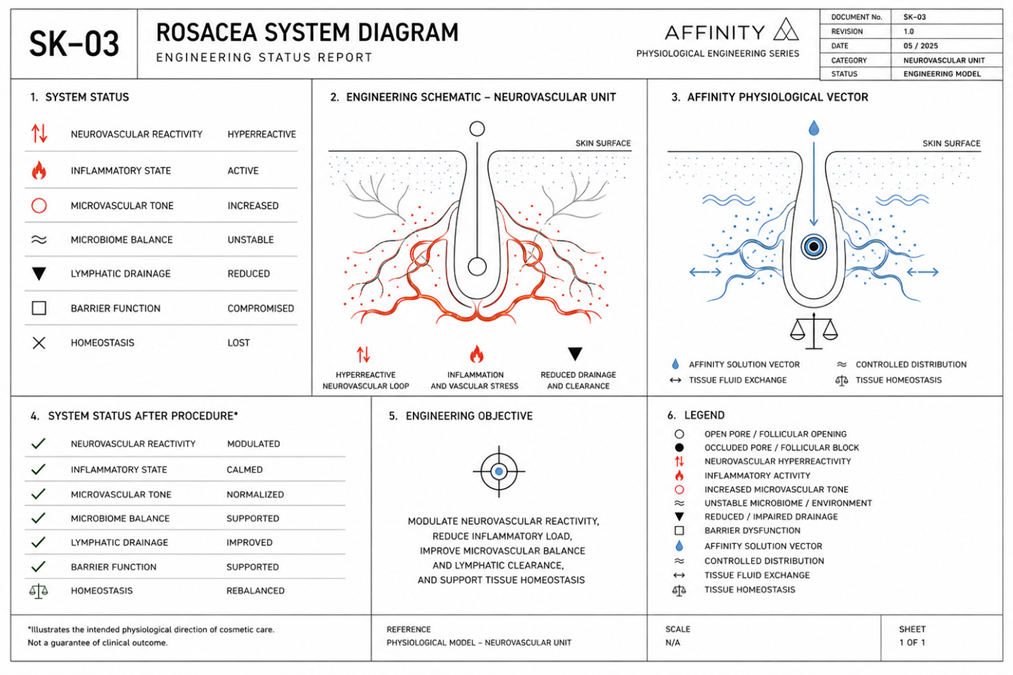
ROSACEA DOES NOT BEGIN WITH REDNESS
Redness is what we see.
But behind it may be a much more complex skin physiology: increased vascular reactivity, neurovascular sensitivity, changes in the skin barrier, local inflammation, alterations in the skin microenvironment, and increased sensitivity to heat, friction, and chemical or mechanical stimuli.
That is why, with rosacea, it is important to consider not only what is applied to the skin, but also how the skin receives that treatment.
WHAT HAPPENS TO THE SKIN?
With rosacea, the skin can become significantly more reactive.
What healthy skin may normally tolerate —
friction → heat → intensive cleansing → aggressive degreasing → active exfoliation
— can become an additional source of irritation for reactive skin.
Therefore, the goal of professional skincare is not to “remove redness” at any cost.
It is to minimize unnecessary stress on the skin while working precisely with the structures that need to be addressed.
AFFINITY: LESS MECHANICAL IMPACT — MORE CONTROL
Affinity Gentle Jet System enables a different approach.
Instead of intensive mechanical action on the skin surface, it uses:
controlled vacuum
↓
contact of the applicator with a small area of skin
↓
delivery of a professional solution
↓
interaction through natural pore and follicular openings
↓
reduced need for aggressive surface treatment
The skin surface does not need to be resurfaced, abraded, or artificially opened.
This is particularly relevant for skin prone to redness and reactivity.
DO NOT DISRUPT THE BARRIER TO WORK WITH THE SKIN
Affinity is not based on the principle: “first disrupt the barrier → then deliver active ingredients.”
Instead, it follows a different anatomical principle: natural opening → natural pathway → controlled action.
A pore is not simply a small opening on the skin surface.
It is part of the complex pilosebaceous unit, connected to the follicle, sebaceous glands, and surrounding tissue.
Therefore, working with the pore area can be viewed not only as surface cleansing, but also as working with the local microenvironment of the skin.
THE AFFINITY APPROACH TO REACTIVE SKIN
With rosacea, the ability to control the intensity of the treatment is particularly important.
There is no need to automatically aim for strong vacuum.
There is no need to pursue a pronounced mechanical effect.
There is no need for intensive exfoliation.
Professional treatment can follow the principle:
minimum necessary impact
→ observe the skin’s response
→ adjust the intensity
→ maintain comfort
→ finish without additional trauma.
This changes the philosophy of the procedure itself.
Not:
“How strongly can we act on the skin?”
But:
“What is the minimum level of stimulation this skin needs right now?”
ROSACEA IS NOT ONLY ABOUT BLOOD VESSELS
It is important not to reduce rosacea to a purely vascular condition.
The skin may simultaneously present with:
Therefore, using the same procedure for every patient with “red skin” is not a rational approach.
One skin type may tolerate a particular stimulus well.
Another may respond with increased burning, warmth, or erythema.
This is why, with reactive skin, it is not only the product or device that matters.
What matters is the physiological dosing of the treatment stimulus.
AFFINITY IS NOT ABOUT MASKING REDNESS
The goal of professional skincare should not be to temporarily “hide” a vascular response.
The goal is to create conditions in which the skin does not have to mount an additional defensive response to the procedure itself.
This is why, when working with reactive skin, particular value can be placed on:
gentle cleansing
→ no abrasive action
→ preservation of the surface barrier
→ controlled solution delivery
→ minimized friction
→ vacuum control
→ monitoring the skin’s response.
WHERE CAN AFFINITY BE PARTICULARLY RELEVANT?
Affinity may be considered as a professional skincare tool:
→ for reactive skin prone to redness;
→ when particularly gentle cleansing is required;
→ to support the skin barrier as part of a comprehensive skincare program;
→ for dry and sensitive skin with reduced tolerance to aggressive procedures;
→ for preparing the skin for subsequent professional treatment steps, when the specific procedure is appropriate for the individual skin condition;
→ in restorative programs between active procedures;
→ for areas where intensive friction and abrasive action are particularly undesirable.
However, in cases of active rosacea flare-ups, pronounced inflammation, pustules, ocular symptoms, or suspected infection, cosmetic technology does not replace dermatological diagnosis and medical treatment.
THE CORE PRINCIPLE
With reactive skin, sometimes the most sophisticated technological solution is not to increase the intensity of the treatment — but to make it more precise.
Affinity follows this logic:
DO NOT DAMAGE → DO NOT OVERLOAD → WORK WITH CONTROL → PRESERVE THE BARRIER.
Not a battle against redness.
Not aggressive cleansing.
Not mechanically suppressing the skin’s response.
Working with the skin through its natural anatomy — with respect for its reactivity.
THE AFFINITY PHILOSOPHY
Across different skin concerns, the principle remains the same:
With acne — work beyond the surface.
With seborrhea — work with the microenvironment.
With rosacea — work with skin reactivity.
Affinity
Working beyond the surface.
Working with the skin’s microenvironment.
Working with the skin’s reactivity.
Redness is what we see.
But behind it may be a much more complex skin physiology: increased vascular reactivity, neurovascular sensitivity, changes in the skin barrier, local inflammation, alterations in the skin microenvironment, and increased sensitivity to heat, friction, and chemical or mechanical stimuli.
That is why, with rosacea, it is important to consider not only what is applied to the skin, but also how the skin receives that treatment.
WHAT HAPPENS TO THE SKIN?
With rosacea, the skin can become significantly more reactive.
What healthy skin may normally tolerate —
friction → heat → intensive cleansing → aggressive degreasing → active exfoliation
— can become an additional source of irritation for reactive skin.
Therefore, the goal of professional skincare is not to “remove redness” at any cost.
It is to minimize unnecessary stress on the skin while working precisely with the structures that need to be addressed.
AFFINITY: LESS MECHANICAL IMPACT — MORE CONTROL
Affinity Gentle Jet System enables a different approach.
Instead of intensive mechanical action on the skin surface, it uses:
controlled vacuum
↓
contact of the applicator with a small area of skin
↓
delivery of a professional solution
↓
interaction through natural pore and follicular openings
↓
reduced need for aggressive surface treatment
The skin surface does not need to be resurfaced, abraded, or artificially opened.
This is particularly relevant for skin prone to redness and reactivity.
DO NOT DISRUPT THE BARRIER TO WORK WITH THE SKIN
Affinity is not based on the principle: “first disrupt the barrier → then deliver active ingredients.”
Instead, it follows a different anatomical principle: natural opening → natural pathway → controlled action.
A pore is not simply a small opening on the skin surface.
It is part of the complex pilosebaceous unit, connected to the follicle, sebaceous glands, and surrounding tissue.
Therefore, working with the pore area can be viewed not only as surface cleansing, but also as working with the local microenvironment of the skin.
THE AFFINITY APPROACH TO REACTIVE SKIN
With rosacea, the ability to control the intensity of the treatment is particularly important.
There is no need to automatically aim for strong vacuum.
There is no need to pursue a pronounced mechanical effect.
There is no need for intensive exfoliation.
Professional treatment can follow the principle:
minimum necessary impact
→ observe the skin’s response
→ adjust the intensity
→ maintain comfort
→ finish without additional trauma.
This changes the philosophy of the procedure itself.
Not:
“How strongly can we act on the skin?”
But:
“What is the minimum level of stimulation this skin needs right now?”
ROSACEA IS NOT ONLY ABOUT BLOOD VESSELS
It is important not to reduce rosacea to a purely vascular condition.
The skin may simultaneously present with:
- vascular reactivity;
- impaired barrier function;
- increased sensory sensitivity;
- changes in the skin microenvironment;
- an inflammatory component;
- dryness or, conversely, seborrheic features.
Therefore, using the same procedure for every patient with “red skin” is not a rational approach.
One skin type may tolerate a particular stimulus well.
Another may respond with increased burning, warmth, or erythema.
This is why, with reactive skin, it is not only the product or device that matters.
What matters is the physiological dosing of the treatment stimulus.
AFFINITY IS NOT ABOUT MASKING REDNESS
The goal of professional skincare should not be to temporarily “hide” a vascular response.
The goal is to create conditions in which the skin does not have to mount an additional defensive response to the procedure itself.
This is why, when working with reactive skin, particular value can be placed on:
gentle cleansing
→ no abrasive action
→ preservation of the surface barrier
→ controlled solution delivery
→ minimized friction
→ vacuum control
→ monitoring the skin’s response.
WHERE CAN AFFINITY BE PARTICULARLY RELEVANT?
Affinity may be considered as a professional skincare tool:
→ for reactive skin prone to redness;
→ when particularly gentle cleansing is required;
→ to support the skin barrier as part of a comprehensive skincare program;
→ for dry and sensitive skin with reduced tolerance to aggressive procedures;
→ for preparing the skin for subsequent professional treatment steps, when the specific procedure is appropriate for the individual skin condition;
→ in restorative programs between active procedures;
→ for areas where intensive friction and abrasive action are particularly undesirable.
However, in cases of active rosacea flare-ups, pronounced inflammation, pustules, ocular symptoms, or suspected infection, cosmetic technology does not replace dermatological diagnosis and medical treatment.
THE CORE PRINCIPLE
With reactive skin, sometimes the most sophisticated technological solution is not to increase the intensity of the treatment — but to make it more precise.
Affinity follows this logic:
DO NOT DAMAGE → DO NOT OVERLOAD → WORK WITH CONTROL → PRESERVE THE BARRIER.
Not a battle against redness.
Not aggressive cleansing.
Not mechanically suppressing the skin’s response.
Working with the skin through its natural anatomy — with respect for its reactivity.
THE AFFINITY PHILOSOPHY
Across different skin concerns, the principle remains the same:
With acne — work beyond the surface.
With seborrhea — work with the microenvironment.
With rosacea — work with skin reactivity.
Affinity
Working beyond the surface.
Working with the skin’s microenvironment.
Working with the skin’s reactivity.