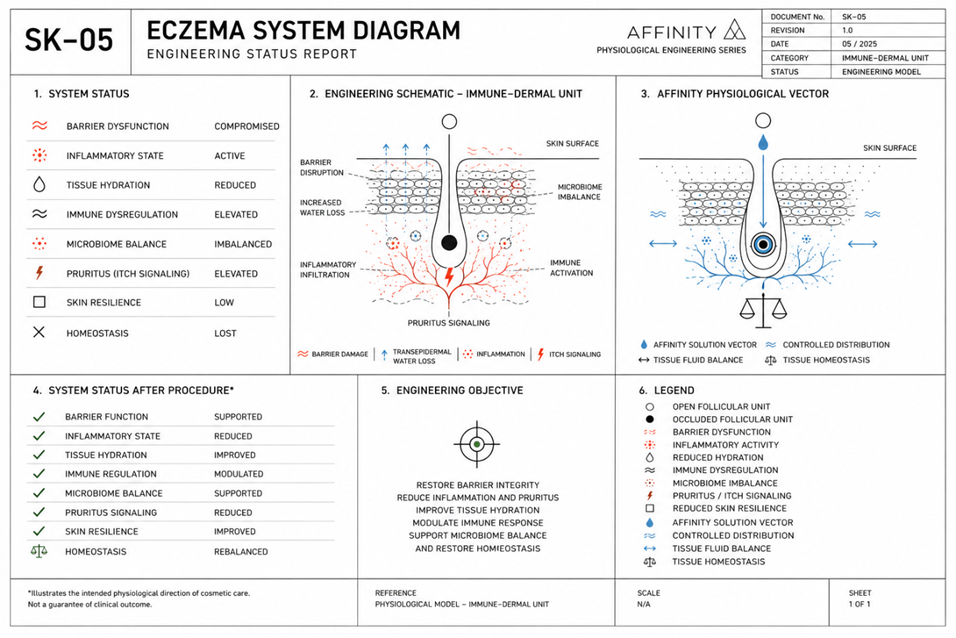
ECZEMA IS NOT JUST DRY OR IRRITATED SKIN
On the surface, we may see:
dryness → scaling → redness → cracking → sometimes weeping.
But behind these manifestations is a disruption in the interaction between the skin barrier, immune system, and external environment.
With eczema, the skin may become significantly more permeable to irritants while also becoming less effective at retaining water.
Therefore, what is a neutral procedure for healthy skin may become an additional burden for eczematous skin.
This raises a fundamental question:
Does the skin need another active intervention — or does it first need us to avoid creating additional damage?
THE SKIN BARRIER IS NOT JUST A SURFACE DETAIL
The stratum corneum is not simply a “layer of dead cells.”
It is a functional barrier system:
corneocytes
+
lipids
+
intercellular organization
+
natural moisturizing factors
↓
control of water loss
↓
protection against external irritants.
In eczema, this system may function less effectively.
Therefore, aggressive cleansing, friction, excessive degreasing, and unnecessary exfoliation may be particularly undesirable.
WHY “PERFECTLY CLEAN” IS NOT THE GOAL
With eczema, it is easy to fall into a familiar cycle:
scaling → remove
dryness → cleanse more intensely
roughness → exfoliate.
But scaling is not contamination.
And inflamed skin is not a surface that needs to be “polished.”
A rational professional approach starts elsewhere:
what does the skin actually need?
↓
what can it tolerate right now?
↓
what is the minimum necessary intervention?
AFFINITY: A DIFFERENT PRINCIPLE OF CONTACT
Affinity makes it possible to work without the need for intensive action on the skin surface.
controlled vacuum
↓
gentle applicator contact
↓
controlled delivery of a professional solution
↓
use of natural pore and follicular openings
↓
minimization of friction and abrasive action.
This is particularly relevant as a principle for organizing professional skincare for skin prone to irritation.
However, this does not mean that an active eczematous lesion should be subjected to vacuum treatment.
On the contrary — the condition of the skin determines whether a procedure is appropriate at all, and where it may be performed.
NATURAL PATHWAYS INSTEAD OF ARTIFICIAL DISRUPTION
Affinity does not require creating a mechanical “channel” through the epidermal barrier.
It works with the skin’s natural anatomy:
pore / follicular opening
↓
controlled solution delivery
↓
working with the surface without the need to disrupt its structure.
This is fundamentally different from the approach:
disrupt the barrier → create access → deliver the active ingredient.
When barrier function is already compromised, the idea of creating additional skin disruption should be considered particularly carefully.
THE VALUE LIES IN GENTLENESS
With eczematous skin, it is impossible to establish in advance:
“this intensity is suitable for everyone.”
The response depends on the stage of the process, barrier condition, location, potential irritants, and current disease activity.
Therefore, the professional approach should be:
assessment
→ evaluation of skin condition
→ selection of the treatment area
→ minimum necessary intervention
→ monitoring the skin’s response
→ stopping if tolerance deteriorates.
Not maximum intensity.
The minimum necessary intervention.
WHERE MAY AFFINITY BE CONSIDERED?
Not as a treatment for active eczema, but as a potential component of professional skincare:
→ for dry and highly sensitive skin outside active lesions;
→ for gentle cleansing during periods when the skin condition is stable;
→ as supportive care between medical treatment stages;
→ for working with surrounding skin when direct treatment of a lesion is undesirable;
→ for skin that does not tolerate intensive mechanical cleansing well;
→ as part of restorative programs after active inflammation has subsided.
WHEN NOT TO “TRY THE DEVICE”
If there is:
weeping
→ erosions
→ bleeding
→ open cracks
→ pronounced acute inflammation
→ signs of infection
→ severe pain
medical assessment should take priority.
It is also important to remember that eczema includes different clinical forms and causes, so conditions that appear similar on the surface may not require the same approach.
AFFINITY SHOULD NOT BECOME ANOTHER IRRITANT
This is perhaps the central principle.
With eczema, the value of a technology is determined not by how intensely it can act on the skin, but by how precisely the professional can control and limit that intervention.
Therefore:
DO NOT STRIP → DO NOT RESURFACE → DO NOT OVER-CLEANSE → DO NOT DISRUPT THE BARRIER → WORK ONLY WHERE AND HOW IT IS APPROPRIATE.
Eczema does not call for greater aggression.
It calls for greater physiological caution.
And this is where the Affinity principle —
working through the skin’s natural anatomy while minimizing unnecessary mechanical impact
— becomes an important tool for professional decision-making.
On the surface, we may see:
dryness → scaling → redness → cracking → sometimes weeping.
But behind these manifestations is a disruption in the interaction between the skin barrier, immune system, and external environment.
With eczema, the skin may become significantly more permeable to irritants while also becoming less effective at retaining water.
Therefore, what is a neutral procedure for healthy skin may become an additional burden for eczematous skin.
This raises a fundamental question:
Does the skin need another active intervention — or does it first need us to avoid creating additional damage?
THE SKIN BARRIER IS NOT JUST A SURFACE DETAIL
The stratum corneum is not simply a “layer of dead cells.”
It is a functional barrier system:
corneocytes
+
lipids
+
intercellular organization
+
natural moisturizing factors
↓
control of water loss
↓
protection against external irritants.
In eczema, this system may function less effectively.
Therefore, aggressive cleansing, friction, excessive degreasing, and unnecessary exfoliation may be particularly undesirable.
WHY “PERFECTLY CLEAN” IS NOT THE GOAL
With eczema, it is easy to fall into a familiar cycle:
scaling → remove
dryness → cleanse more intensely
roughness → exfoliate.
But scaling is not contamination.
And inflamed skin is not a surface that needs to be “polished.”
A rational professional approach starts elsewhere:
what does the skin actually need?
↓
what can it tolerate right now?
↓
what is the minimum necessary intervention?
AFFINITY: A DIFFERENT PRINCIPLE OF CONTACT
Affinity makes it possible to work without the need for intensive action on the skin surface.
controlled vacuum
↓
gentle applicator contact
↓
controlled delivery of a professional solution
↓
use of natural pore and follicular openings
↓
minimization of friction and abrasive action.
This is particularly relevant as a principle for organizing professional skincare for skin prone to irritation.
However, this does not mean that an active eczematous lesion should be subjected to vacuum treatment.
On the contrary — the condition of the skin determines whether a procedure is appropriate at all, and where it may be performed.
NATURAL PATHWAYS INSTEAD OF ARTIFICIAL DISRUPTION
Affinity does not require creating a mechanical “channel” through the epidermal barrier.
It works with the skin’s natural anatomy:
pore / follicular opening
↓
controlled solution delivery
↓
working with the surface without the need to disrupt its structure.
This is fundamentally different from the approach:
disrupt the barrier → create access → deliver the active ingredient.
When barrier function is already compromised, the idea of creating additional skin disruption should be considered particularly carefully.
THE VALUE LIES IN GENTLENESS
With eczematous skin, it is impossible to establish in advance:
“this intensity is suitable for everyone.”
The response depends on the stage of the process, barrier condition, location, potential irritants, and current disease activity.
Therefore, the professional approach should be:
assessment
→ evaluation of skin condition
→ selection of the treatment area
→ minimum necessary intervention
→ monitoring the skin’s response
→ stopping if tolerance deteriorates.
Not maximum intensity.
The minimum necessary intervention.
WHERE MAY AFFINITY BE CONSIDERED?
Not as a treatment for active eczema, but as a potential component of professional skincare:
→ for dry and highly sensitive skin outside active lesions;
→ for gentle cleansing during periods when the skin condition is stable;
→ as supportive care between medical treatment stages;
→ for working with surrounding skin when direct treatment of a lesion is undesirable;
→ for skin that does not tolerate intensive mechanical cleansing well;
→ as part of restorative programs after active inflammation has subsided.
WHEN NOT TO “TRY THE DEVICE”
If there is:
weeping
→ erosions
→ bleeding
→ open cracks
→ pronounced acute inflammation
→ signs of infection
→ severe pain
medical assessment should take priority.
It is also important to remember that eczema includes different clinical forms and causes, so conditions that appear similar on the surface may not require the same approach.
AFFINITY SHOULD NOT BECOME ANOTHER IRRITANT
This is perhaps the central principle.
With eczema, the value of a technology is determined not by how intensely it can act on the skin, but by how precisely the professional can control and limit that intervention.
Therefore:
DO NOT STRIP → DO NOT RESURFACE → DO NOT OVER-CLEANSE → DO NOT DISRUPT THE BARRIER → WORK ONLY WHERE AND HOW IT IS APPROPRIATE.
Eczema does not call for greater aggression.
It calls for greater physiological caution.
And this is where the Affinity principle —
working through the skin’s natural anatomy while minimizing unnecessary mechanical impact
— becomes an important tool for professional decision-making.